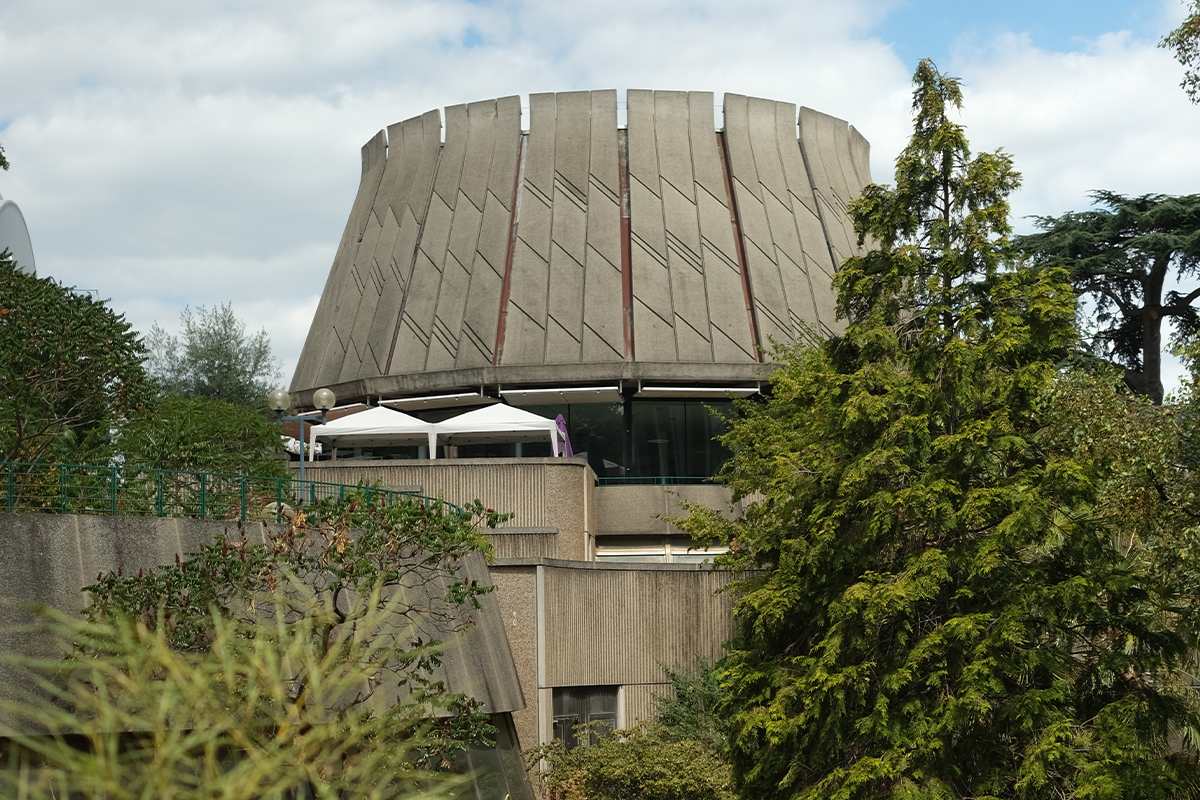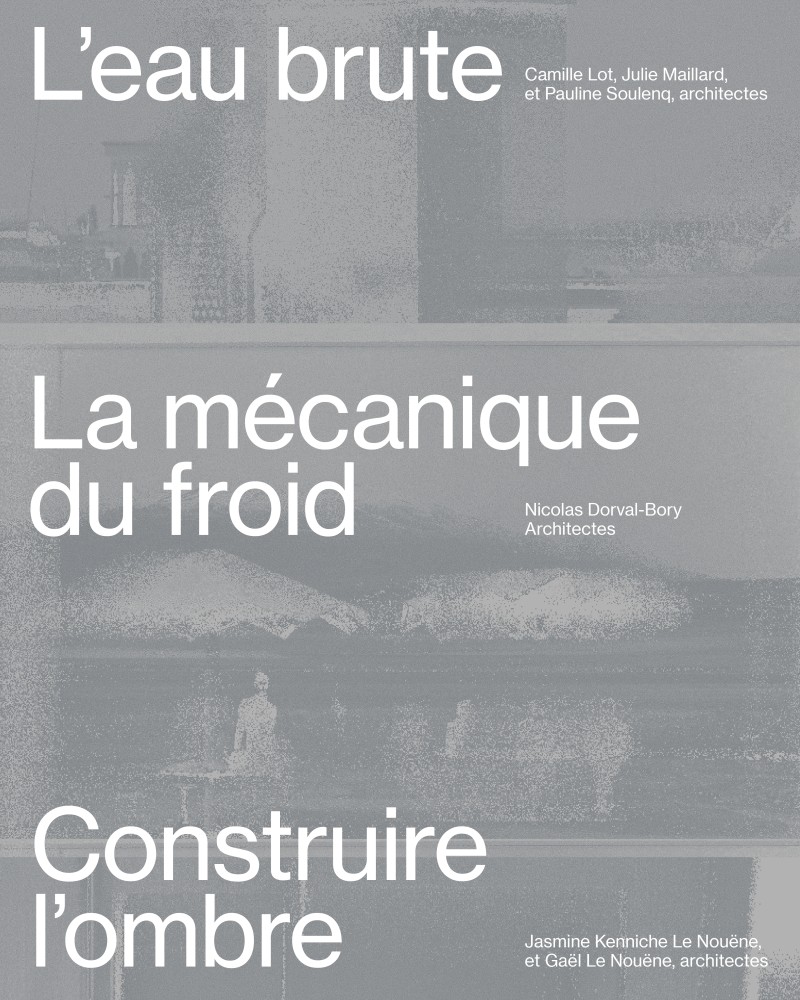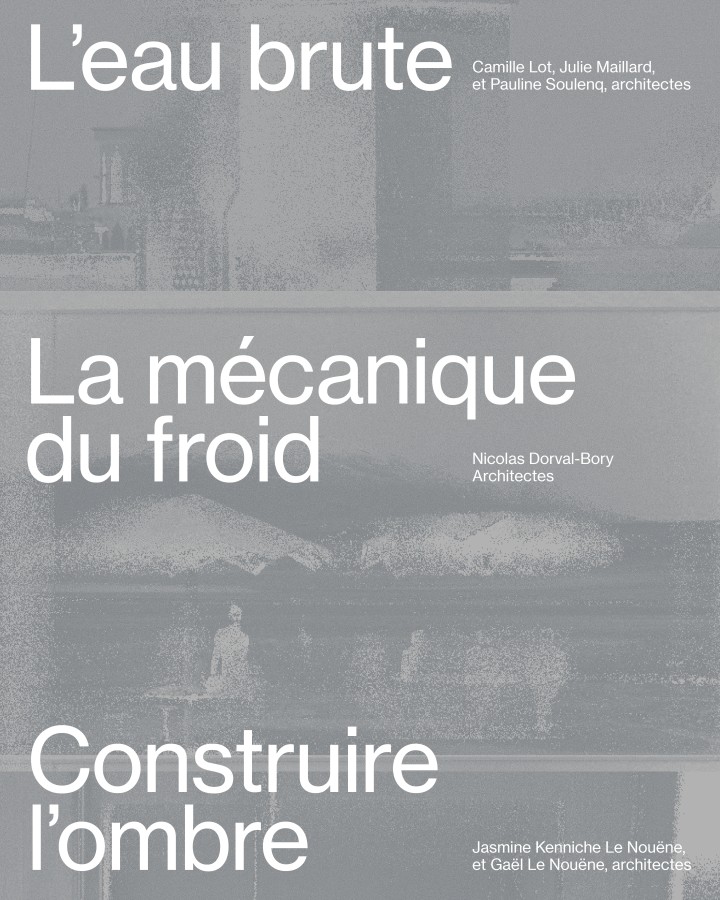
Like a laboratory, Nouveaux Climats experiments with a city in which water, coolness, and shade are common goods—resources for the territory and for living beings. Heat waves, droughts, floods: here, the climate is no longer merely a context in which architecture is situated and which it endures; it becomes the very substance of the project. How can we work with—rather than against—the existing natural and built environment? This group exhibition sketches out a new landscape centered on three architectural, urban, and landscape research projects stemming from the FAIRE call for proposals, exploring alternatives for rethinking climate adaptation.
Raw water, from the subsurface to the surface—enriched by everything it passes through—is revealed by Camille Lot, Julie Maillard, and Pauline Soulenq through its interstices, colors, scales, and sometimes underestimated virtues. Exploring the mechanics of cooling, Nicolas Dorval-Bory Architectes examines and creates a dialogue between vernacular systems and modern cooling mechanisms. Finally, shadow is conceptualized, revealed, and then reimagined in our built environments through the work of Jasmine Kenniche Le Nouëne and Gaël Le Nouëne.
These research projects share the challenge of making tangible what eludes the usual tools of design. Water flows between layers hidden from everyday use; temperatures are felt but remain imperceptible; and shadows shift with the sun, slipping away from us in an instant. Conventional graphic representation methods are insufficient to capture these phenomena. The three projects thus invent their own instruments: a stratigraphic atlas, a refrigerated alphabet book, heliocentric shots, infrared photographs, and even an inventory of manufactured objects. The prototypes, for their part, become a way of understanding through doing—tools for grasping reality through sensory experience rather than through explanation.
The exhibition focuses on Paris, its metropolitan area, and its international resonance. This dense, built-up landscape—resting on a subsoil saturated with utility networks—has long kept at bay whatever passes through it. Water is most often channeled or buried, temperature is regulated by machines, and shade is left to the whims of the built environment’s morphology. In the face of global warming, the city must rethink how it provides comfort, how people live, and how it protects itself. Rather than offering fixed solutions, *Nouveaux Climats* showcases new tools, processes, and methods for working with the elements and turning the climate into a resource.Raw Water
The Greater Paris metropolitan area is facing water scarcity and an increase in heat waves and intense, brief, and irregular rainfall, revealing Paris’s inability to be resilient. Raw water is found in the environment; it has not been treated and contains all minerals, ions, particles, bacteria, and parasites. This resource can become a true common good for residents. Conducting research on raw water means viewing it as an adaptation tool present in various forms throughout the city and its surrounding area. It is visible on multiple scales: the Seine, rain, rivers, canals, rooftops, gutters, gargoyles, drainage channels, manholes, outlets, cornices, reservoirs, basins… The “Raw Water” research project aims, on the one hand, to reveal the ingenuity of existing systems and, on the other hand, to enable users to interact with raw water through trans-scalar, low-tech architectural and landscape solutions. Green, gray, brown, and blue waters represent underutilized potential that should be harnessed, amplified, and shared. Harnessing this potential helps, among other things, to increase biodiversity and urban coolness, conserve drinking water, and envision new uses.
Research conducted by Camille Lot, Julie Maillard, and Pauline Soulenq, architects
The Mechanics of Cooling
Although Paris, since its founding, has been a temperate city where the main challenge to comfort is heating, the capital’s future is nevertheless unfolding within a new geological and climatic era. With the prospect of scorching summers reaching up to 50°C in a few decades, Paris is inexorably approaching the current climate of Seville. But the city must evolve so that its residents can continue to live there comfortably, despite its existing architectural structure, which is necessarily ill-suited to these conditions. Beginning by identifying Parisian climate control systems throughout its history, the study then seeks to understand the physical principles of cooling and the ways in which other cultures have integrated its production, conservation, and distribution into architecture. Finally, drawing on Parisian projects and case studies, the research proposes several architectural and technical strategies to envision a comfortable and frugal climatic future.
Research conducted by Nicolas Dorval-Bory Architects
Creating Shade
Based on scientific findings that indicate global warming in our cities, it is essential—as architects and residents of Paris—to reflect on ways to protect against heat and bring coolness to the city without resorting to technical solutions that consume energy. This involves drawing on the most fundamental elements and determining the role of shade in our daily urban lives. Just like natural light, shade is a universal right and contributes to thermal comfort. Light propagates through the absence of matter; shade exists through the presence of matter. It is the result of light interacting with a plane or a mass. The physical element that enables the very existence of shadow can be horizontal, vertical, or oblique; opaque or openwork; thin or thick. Its shape can be geometric or random. It must be distinct from and at a distance from the ground in order to cast a shadow there. It is intimately linked to the presence of trees. Nevertheless, in Paris, due to the presence of infrastructure, tree plantings do not always allow for a continuous path in the shade. How can the need for shade be incorporated into a defined urban, landscaped, and architectural environment? What architectural typologies facilitate shade? What are the essential characteristics of the design solutions to be considered?
Research conducted by Jasmine Kenniche Le Nouëne & Gaël Le Nouëne, architects